REFORMING LAW AND POLICY IN CAYMAN

Land Administration Reforms
I have been working to change Cayman law and policy for the better. There have been various opportunities I have taken to initiate reform and influence its direction.
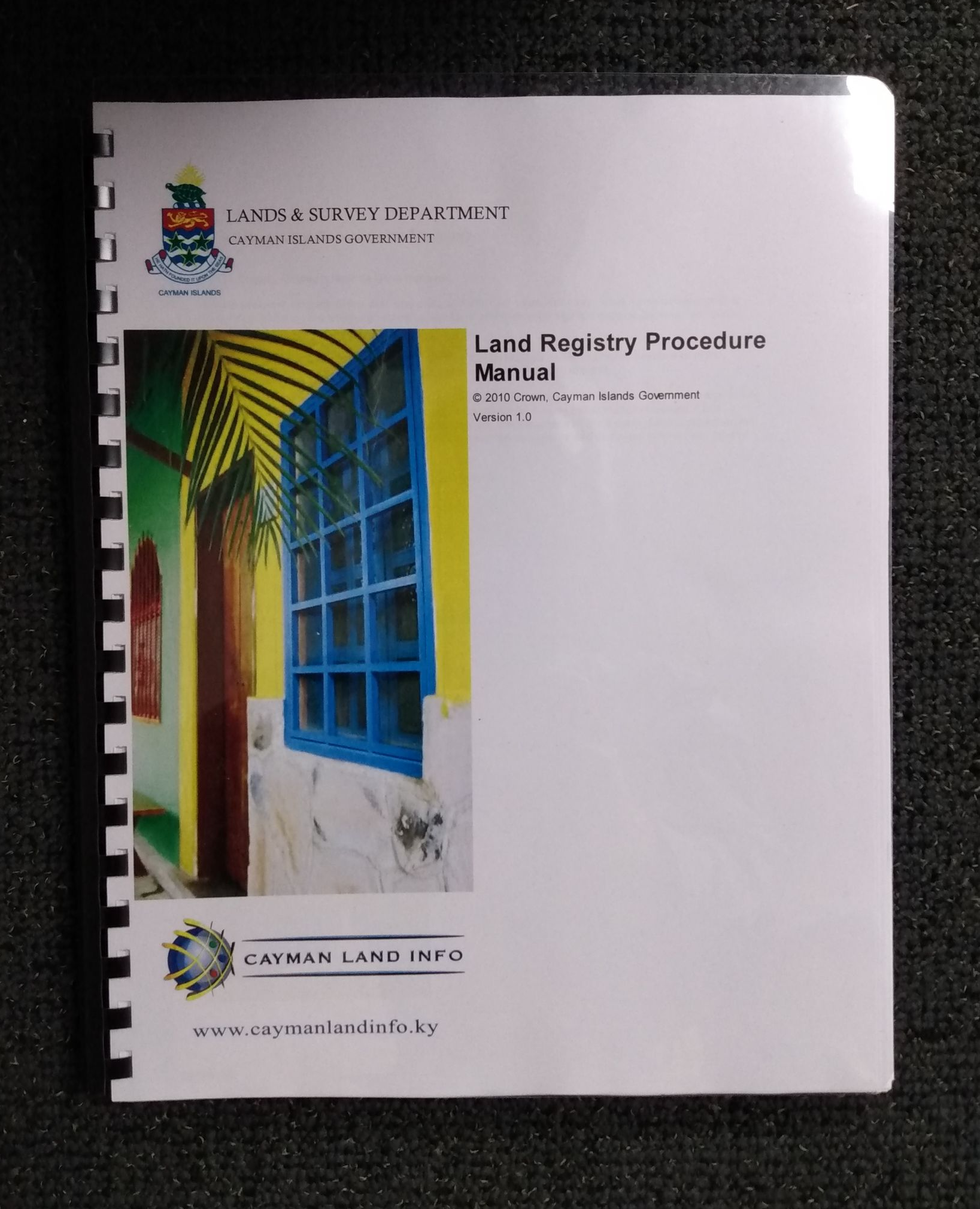
I identified a pressing need for a new set of written procedures for the land administration systems in the Cayman Islands Land Registry. It was still using written procedures, referring to pen-and-ink notes on paper registers, even after the land registry had already moved to electronic systems.
I ran a two-year project, during which the registry hosted me for a period to examine internal practices and interview all staff. From this fact-finding, coupled with analysis of the legal context, I carried out a comprehensive review of procedures, I assessed the requirements for change, and I drafted new regulations. They were signed into law. I incorporated them into a new Land Registry Procedure Manual.
The new Procedure Manual I wrote contains over 140 pages of policy on the internal procedures, including important new protocols that I recommended (located here and downloads here). It was warmly received by the Director and the Solicitor General:
"I believe we now have a top quality product"
- Director of Lands & Survey (see here)
"excellent...will benefit the Cayman Islands as a whole...
a sterling achievement"
- Solicitor General (see here)
The Manual has been the foundation for Land Registry operations in Cayman over the last 15 years. It was also offered to the land registries in Anguilla and the Turks & Caicos Islands.
The Manual was relied upon by the judges of the Privy Council in a recent case
(see here).
Legal Reforms
A long-running source of concern for citizens and land registry has revolved around the access to old land title deeds that were handed to civil servants for land registration during the 1970s cadastral process. Over many decades, concerned citizens have been seeking access without much success. I was asked to produce analysis and recommendations for dealing with this problem.
My solution was adopted by the Freedom of Information Commissioner in an important ruling (filed here and downloads here) see para.5. It now sets the law on this topic. It led to an immediate change in written policy by the Lands & Survey Department to reflect it (filed here and downloads here). I have spoken to land registries in other British Overseas Territories to recommend similar solutions (Montserrat, British Virgin Islands; also Antigua).
My experience has also equipped me to contribute constructively to law changes through the Law Reform Commission of the Cayman Islands. They recently prepared reforms to the law of squatters. I was able to analyse the problems and provide advice for their draft Bill (see here).
The Law Reform Commission also developed reforms to the law of land held in family settlement. This is an extraordinarily difficult area and I was instrumental in redirecting the content of the reforms. My published articles were relied upon as the basis for ideas in the law reform commission's Consultation Paper (see here). I was the sole member of the public to respond to their consultation. My extensive analysis was quoted in full and acted upon in the Final Report (see here para 16 and appendix 3) which led to the draft Bill.


Inquiries and Adjudications
I was temporarily appointed to an ombudsman role on two occasions to run inquiries into property issues. They related to allegations of Caribbean land registry maladministration and flawed ministerial grants of Crown land.
The allegations were instigated by the Leader of the Opposition and made allegations involving the Premier so they were politically sensitive and made headline news in the national press (see here and here).
After making findings, my final report required technical reforms to land registry practices, as well as various legal, procedural and resource reforms to be made to the Lands & Survey Department. Those requirements were accepted and implemented in full.
Beach Policy
I have influenced the development of policy in various other contexts, including beaches. In the British Overseas Territories, they are crucial national land resources and an important area where law should keep up with contested and intensifying usage.
I have written on the law of beaches in Montserrat (where volcanic deposits have created new problems) and I also proposed reform to beach law in the Turks & Caicos Islands which is currently being implemented (see here).
In Cayman, I was active as a member of the Cayman Beach Erosion Committee in the 1990s for which I produced a briefing on legal implications of some possible remedial actions.
A quarter of a century later, I was invited by the Ministry of Lands to write a report on Public Beach Access Rights - a very contentious issue because of the conflicting social pressures on this limited resource. This substantially redirected policy and I worked with the legislative draftsman with a view to creating a new draft Bill (see here).
E-Conveyancing Reform
In 2018, the Eastern Caribbean Currency Union (which includes the British Overseas Territories of Montserrat and Anguilla) floated a policy proposal for an electronic cross-border system for recording land titles which would enable out-of-country conveyancing (see here). I wrote a substantial report containing many recommendations for the ECCU (downloads here). The ECCU acted in accordance with my primary policy recommendation to hold off until the necessary infrastructure could be put in place against systemic risks which I identified. I was able to draw on my recent advice to the land registrar of the Republic of Ireland about systemic risks in their electronic conveyancing reforms, a topic on which I had recently published (see here).
